Having been home to several civilizations, the nation known today as Pakistan is a country with a rich cultural and historical fabric. Its strategic importance is also growing by the day, as it stands at the intersection of the Middle East, and Central and Southeast Asia, which play such an important role in world politics, or in other words, along the world’s oil corridors. Yet since it harbors numerous ethnic communities that share a common Islamic faith but are not properly welded together, the country is also the scene of much conflict based on sectarian divisions. In particular, there is an unending power struggle between Punjabis, Sindhis, Baluchis and Pashtuns. Add to this the tensions caused by problems such as tribal affiliations, political and sectarian divisions and ethnicity, acts of terror by al-Qaeda and the Taliban, ongoing border disputes with India, the departure of what was East Pakistan under the new name of Bangladesh, endless conflicts of the Afghan border and economic difficulties, and life in Pakistan becomes highly problematic.
In addition, as a country that has spent half of its 68-year political history under military rule, Pakistan deserves credit for the steps it has taken toward democracy in recent years. Power in Pakistan, which spent decades deprived of democracy since independence in 1947 and has regularly witnessed coups, first changed hands through elections in May 2013. For the first time, an elected government managed to serve out its entire term, meaning that Pakistan had successfully taken the first step on the long road to democracy.
Another success of the elections was the 60% turnout. Before the elections, the Pakistan Taliban killed more than 130 people, including electoral candidates, and spread terror throughout the country. Even so, the public risked their lives to get to the ballot boxes, and the election duly took place, albeit under the shadow of acts of terror. This high turnout revealed how seriously the population desired democracy. The army, a formidable presence even under 34 years of civilian rule, restored the people’s confidence in it through its support for the democratic process.
Clear efforts are being made to achieve democracy in the country. However, there are still many problems that need to be solved, such as a lack of consensus on the form that relations between the state and religion should take, religious, sectarian and ethnic clashes and basic issues of identity, and other questions that need to be addressed promptly arising from Pakistan’s federal system, such as power imbalances between the provinces.
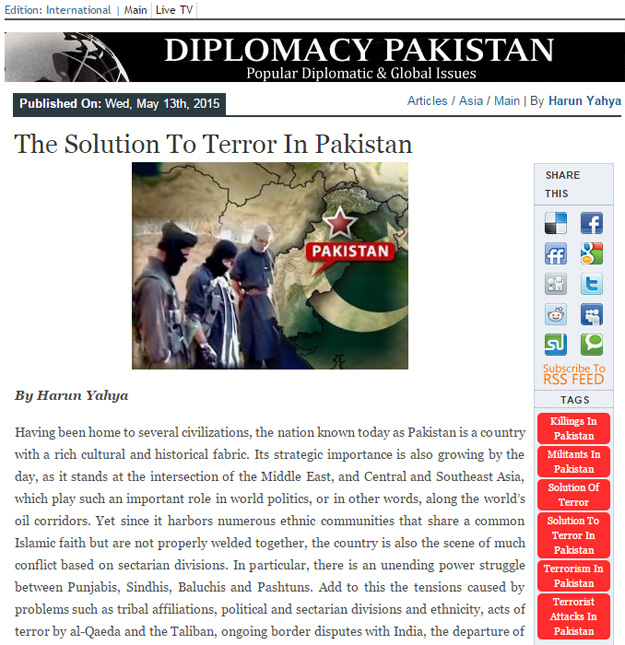
Pakistan’s greatest problem is the Tehreek-e Taliban Pakistan, or Pakistan Taliban. This organization has come to represent a major threat to national security with its attacks in recent years, is weakening the country, damaging its prestige at the global level and placing Pakistan at the top of the terror lists. Following an airport attack in June 2014, the Taliban attracted the attention of the entire world public with an attack on a school in Pashawar in December, in which 148 innocent people lost their lives, mostly children and teachers. It then led to the deaths of dozens more people one month later in an attack on a Shiite mosque and in an assault last month on a Catholic school in the city of Lahore.
The government restored the death penalty last month, and many Taliban members have been executed. While anti-terror operations were taking place, Pakistan experimented with its first own domestically produced drones, and the General Staff announced that they would be more effective in the fight against terror from now on.
Pakistan, which will now be producing its own unmanned aerial vehicles (UAVs), has in fact long been the target of drone attacks that have caused the deaths of a good many innocent people in attacks on civilian areas. American UAVs have carried out some 400 attacks in Pakistan over the last 11 years and have led to the deaths of more than 3,400 people, the majority of them civilians. According to the London-based Bureau of Investigative Journalism (BIJ), 61% of the targets in drone attacks have been civilian settlements. UAVs are known to mainly target civilian buildings such as homes, madrassas and mosques. Susan Schuppli, a senior researcher, says that the real victims of UAVs are civilian women and children caught in homes when they are bombed. Amnesty International also says that the UAV operations conducted by the USA are a violation of international law, and may even fall under the category of war crimes. Yet despite all these condemnations, the buying and selling of UAVs between countries is growing all the time.
Countries are blatantly and carelessly ignoring the fact that the killing of civilians is murder. They have ostensibly convinced themselves that this is the only way of dealing with terror organizations. Yet even if security measures are sometimes instrumental in success against individuals involved in radical terror organizations, they do not get rid of the organizations themselves; the problem of terror cannot be resolved through force alone. In particular, radical organizations with false conceptions of religion, such as the Pakistani Taliban, are bodies that harbor people with an ideology, albeit a false one, and who are even prepared to die for these false values which they believe to be true. Therefore, so long as the false ideas they hold are not neutralized by true ideas, it is impossible for such organizations to be eliminated.
What needs to be done at this point is to make it clear that the ideas espoused by terror organizations, who as a general rule act out of a radical and erroneous conception of religion, have no place in Islam and that the way of thinking they have developed in the light of fabricated hadiths and other nonsense is in no way compatible with Islam. Islam is a religion of love, brotherhood, affection, compassion, tolerance, peace, union and unity. The correct solution is to adopt a policy of education in which these facts are set out with full supporting evidence from the Qur’an, the true source of Islam. Indeed, regarding UAVs as the answer – and imagining that responding to violence with more violence can put an end to terror – will in fact create an even greater danger.
We hope that our brother country, Pakistan, with which we share a common culture and values, will soon resolve all its problems, and particularly the scourge of terror, that it will take sound steps on the passage to democracy and that the country’s innocent and sincere people will soon attain the security they deserve.
Adnan Oktar's piece on Diplomacy Pakistan: